Root canal treatment
Precise cleaning, disinfection and sealing of the inside of a tooth whose nerve is inflamed or infected — relieving the pain and keeping the tooth in place.
Learn moreLutterworth · South Leicestershire
Angel Ognemirov, MSc Endodontics, provides root canal treatment, retreatment and emergency endodontic care for patients from Lutterworth and south Leicestershire: a diagnosis confirmed by testing, modern technique throughout, and a calm, unhurried approach for anyone who finds dental treatment difficult.
Diagnosis first. Precision throughout. Your natural tooth at the end of it.
Call 0116 270 0550 and say that your symptoms are urgent — acute pain and swelling are seen as a priority.
Emergency endodontic treatmentWhat endodontic treatment is
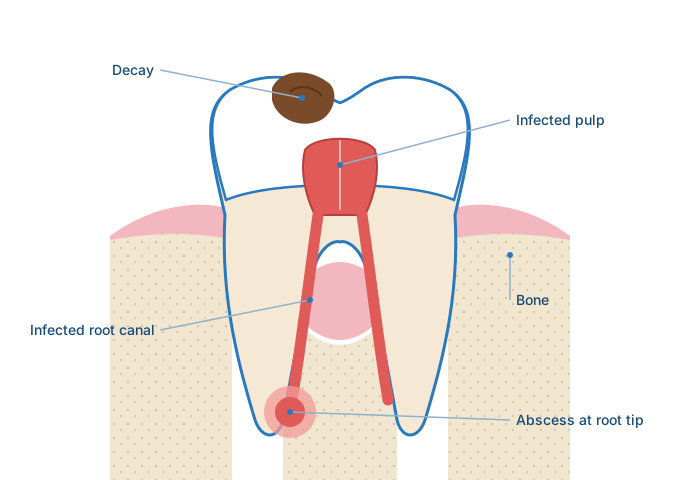
Running through the centre of every tooth is a narrow chamber of nerve and blood vessels. When decay, a crack or an injury lets bacteria reach it, the result is the deep, pulsing pain most people associate with "needing a root canal" — and, if nothing is done, an infection that spreads into the jaw.
Endodontic treatment is the discipline that deals with this hidden space. Root canal treatment, retreatment of failed root fillings, root-end surgery and the management of cracked and injured teeth all share the same purpose: to remove the disease inside the tooth so that the tooth itself can remain.
This is the work Angel Ognemirov concentrates on. Your own dentist remains your dentist; the inside of the tooth is treated here and handed back ready to be restored, with a full report.
Treatments
Root canal treatment, retreatment of teeth treated elsewhere, precise assessment of tooth pain and prompt emergency care — every service begins with a confirmed diagnosis and a plan you can read.
Precise cleaning, disinfection and sealing of the inside of a tooth whose nerve is inflamed or infected — relieving the pain and keeping the tooth in place.
Learn moreWhen a previous root canal treatment has not held, retreatment removes the old filling, deals with missed or re-infected canals and seals the tooth again.
Learn moreA targeted surgical procedure to remove infection at the tip of a root when it cannot be reached from inside the tooth — a precise way to save a tooth that would otherwise be lost.
Learn moreSharp pain on biting is often a crack. Pinpointing it, and judging how deep it runs, is what decides whether the tooth can be protected or needs treatment.
Learn moreKnocked, chipped, loosened or knocked-out teeth need prompt treatment and careful monitoring, because the nerve inside an injured tooth can fail silently months later.
Learn moreDental anxiety should never cost you a tooth. A clinician trained in dental sedation, anaesthetic checked before anything starts, an agreed signal to pause and all the time you need.
Learn moreToothache rarely points to its own cause. A structured consultation establishes which tooth is responsible and what it needs — sometimes no treatment at all.
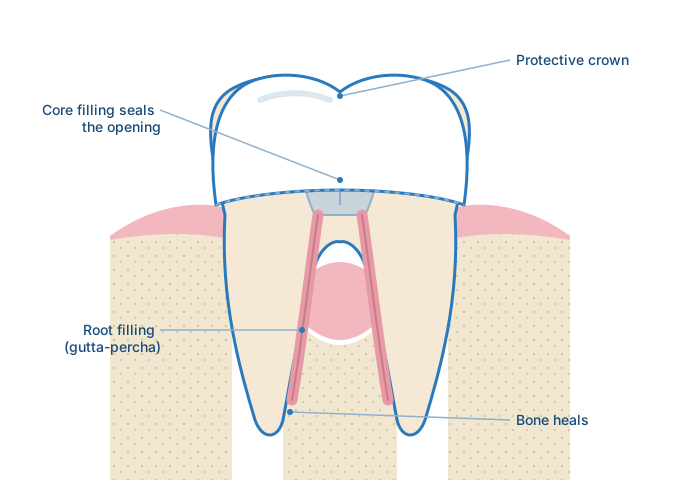
Learn moreInfection sealed inside a tooth is beyond the reach of antibiotics. Cleaning and sealing the canal system removes the source so the bone can heal and the tooth can stay.
Learn moreBeen told a tooth must come out? A precise assessment of whether it can be saved, with the options and their likely success set out in writing.
Can my tooth be saved?The process
Book online or telephone. Tell us if you are in pain, whether your dentist has seen the tooth and if recent X-rays exist.
History, examination, nerve and bite tests and any X-rays required. You leave with a written diagnosis, a plan and the fee — or confirmation that no treatment is needed.
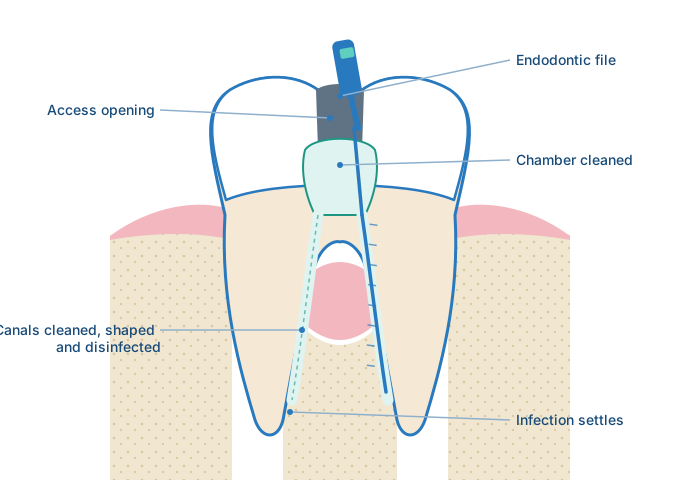
Under local anaesthetic, the canal system is measured, cleaned, disinfected and sealed, usually in one visit. Emergency patients are made comfortable first.
Your dentist fits the protective crown or filling. Healing of the bone is confirmed on a later X-ray, and your dentist receives our report.
Treatment for dental anxiety
A good number of the teeth seen here have been hurting for months before anyone picks up the phone — not because the pain was bearable, but because the prospect of treatment felt worse. Angel understands that, and treating people who are frightened of dental care is one of the things he is most interested in doing well.
The method is simple and it works: you hear exactly what will happen before it happens, the anaesthetic is checked before any instrument is picked up, you agree a signal that stops everything at once, and the appointment is long enough that nothing is rushed. Because Angel has completed training in oral and intravenous dental sedation at Guy's Hospital in London, sedation can also be considered where it is appropriate — something to talk through at your consultation.
Say you are nervous when you book. You stay in charge of the appointment from the first minute to the last.
Emergency endodontic treatment
Toothache that starts on its own, lingers after a hot drink or pulses at night signals a nerve that is inflamed or has died. Painkillers blunt it for a few hours; they do not treat it, and an untreated infection can spread.
Get in touch and say your symptoms are urgent. We will see you as promptly as we can, relieve the pain and plan the remaining treatment for a time that suits you.
Seek medical help immediately if a swelling is spreading quickly, swallowing or breathing is difficult or you feel very unwell: contact NHS 111 or go to A&E.

About me
MSc Endodontics, University of Chester
Angel Ognemirov holds an MSc degree in Endodontics from the University of Chester. He has completed training in oral and intravenous dental sedation at Guy's Hospital in London.
Angel focuses on providing high-quality endodontic care, particularly for patients who experience dental anxiety. His patient-centred approach combines modern endodontic techniques with a calm and supportive treatment experience.
He also holds a certificate in Restorative Dentistry and is an active member of the Society for the Advancement of Anaesthesia in Dentistry (SAAD).
Angel sees patients from Lutterworth, Broughton Astley, Market Harborough, Rugby and the villages between — by referral from their dentist or by booking directly.
Modern endodontics
A root canal may be narrower than a hair, curve sharply and divide without warning, and a molar often has more canals than first appear. Treatments fail for precise reasons: a canal missed, a root filling that stops short, a seal that leaks.
Modern endodontic practice answers each of them — magnification to see the floor of the tooth clearly, electronic measurement of the length of each root, flexible instruments that follow the canal's natural curve, and disinfectant carried into the fine branches that instruments cannot reach.
No clinician can guarantee a result, and we will not pretend otherwise. What precision does is give your tooth the best possible chance of healing and lasting.
Technology is only as good as the judgement behind it. Diagnosis and an honest view of the tooth's outlook come first; precision carries out the plan.
Why keep the natural tooth
A natural tooth sits on a ligament that senses how hard you bite and keeps the bone around it healthy. It needs no surgery to place, costs less over a lifetime than any replacement and, properly treated and restored, can last for decades.
An infected tooth, a failed root filling or a canal that proved difficult for someone else is not, on its own, a reason to lose the tooth. We assess each one on its merits and give you a written view of the realistic options and their likely success.
Where extraction genuinely is the right course, we say so plainly and help your dentist plan the replacement. Where the tooth can be saved, we show you how.
Questions answered
Direct answers to the questions we hear most. The patient guides go further.
Treatment of the inside of the tooth — the nerve, the root canals and the infections that follow when they are damaged. It includes root canal treatment, retreatment, root-end surgery and the care of cracked and injured teeth, always with the aim of keeping the natural tooth.
Your own tooth keeps the ligament and bone around it healthy, needs no surgery to place and generally costs less over a lifetime than an implant or bridge. Replacement is the right answer only when a tooth genuinely cannot be restored — and we will tell you honestly if that applies.
The tooth is numbed and isolated, a small opening is made, and each canal is measured, cleaned, disinfected and sealed. Most teeth are completed in one visit of 60 to 90 minutes; your dentist then fits a crown or filling to protect the tooth.
With the tooth properly numbed, no. What you feel is pressure and vibration; if anything sharp breaks through, we pause and add more anaesthetic before continuing. A few days of tenderness afterwards is normal.
Quite a lot. Treating anxious patients is a particular interest of Angel's: every step is explained before it happens, the anaesthetic is checked first, you can stop the appointment with a signal at any time and nothing is hurried. Angel has also completed training in oral and intravenous dental sedation, so sedation can be discussed where it is appropriate. See treatment for dental anxiety.
When pain lingers after hot or cold, starts by itself or wakes you; when a tooth is tender to bite on; when there is a swelling or a spot on the gum; when a tooth has darkened; or when your dentist has found a problem on an X-ray. If in doubt, a consultation settles it.
Usually retreatment: the old root filling is removed, any missed or re-infected canals are cleaned and the tooth is sealed again. Where the problem cannot be reached from inside the tooth, microsurgery removes the infected root tip. Only a tooth with a split root or too little sound structure needs extraction.
No. Many patients contact us directly. If your dentist has already seen the tooth, let us know what they found and we will write to them after your visit.
All dentists are trained to carry out root canal treatment. A practice devoted to endodontics does this work daily with the time, magnification and technique it demands, which matters most for molars, retreatments, cracks and cases that have already proved difficult. In the UK, the title "specialist" may be used only by dentists on the General Dental Council's specialist list.
They may calm a swelling briefly, but they cannot reach bacteria sealed inside a dead tooth. The infection returns when the course ends; only treatment of the canal system removes the cause.
Fees depend on the tooth and the complexity of the work. The exact figure is confirmed in writing after your consultation and before treatment begins, and it will not change part-way through.
Use the “Book an Appointment” button to book online, or telephone 0116 270 0550. Mention whether you are in pain, whether your dentist has looked at the tooth and whether recent X-rays exist; you will then be offered the earliest suitable consultation. The contact page has the details.
Book an Appointment
Referred by your dentist, seeking a second opinion or in pain today — book online in a minute, or call to speak to someone who can arrange the earliest suitable consultation for Lutterworth and the surrounding area.
Severe pain or a swelling? Say so when you call and we will find you the earliest possible time.